
Ecologists | Еколог

Ivan Moysiyenko
Ecologist
Ivan Moysiyenko is a distinguished Ukrainian ecologist and the Head of the Department of Botany at Kherson State University and is the Founding Member of the Board of the NGO Ukrainian Nature Conservation Group. His extensive research encompasses nature conservation, plant conservation biology, and landscape ecology, with a particular focus on the biodiversity of Ukraine's steppe regions.
A significant aspect of Moysiyenko's work involves studying the ecological importance of cultural heritage sites, such as kurgans (ancient burial mounds), hillforts, old parks, and cemeteries, which serve as refugia for biodiversity. His research has demonstrated that these sites are crucial for preserving various plant species, especially in the intensively cultivated landscapes of southern Ukraine.
Through his dedicated efforts, Ivan Moysiyenko contributes significantly to understanding and mitigating the environmental impacts of war on Ukraine's natural and cultural heritage, advocating for the protection and restoration of these vital ecological refuges.

Ivan Rusev
Ecologist, Director of the
Tuzly Lagoons National Nature Park
Ivan Rusev is a renowned ecologist and the director of the Tuzly Lagoons National Nature Park. With over three decades dedicated to environmental conservation, Rusev has been instrumental in restoring the connection between coastal lagoons and the Black Sea, facilitating vital fish migration routes.
During the war, his efforts have been severely hampered as military activities have rendered these areas inaccessible, leading to disrupted ecosystems and declining fish populations. Rusev has also raised alarms about the mass deaths of dolphins in the Black Sea, attributing these fatalities to military sonar usage and underwater detonations. An estimated 50,000 dolphins have been killed so far during the war, though this number may be far higher.

Kateryna Polyanska, PhD.
Ecologist
Kateryna Polyanska is an ecologist affiliated with Environment People Law (EPL), specializing in biodiversity conservation and environmental policy. She is also a fellow of the True Costs Initiative.
During the war, Polyanska has focused on assessing the impacts of military actions on Ukraine's natural habitats and species. She has been involved in field studies documenting habitat destruction and species displacement, providing crucial data to support legal actions against environmental violations.
Polyanska's work contributes to developing strategies for ecological restoration in post-conflict Ukraine.

Oleksander Khodosovtsev
Ecologist
Oleksander Khodosovtsev is a professor at Kherson State University and a member of The National Academy of Sciences of Ukraine. Khodosovtsev is a Ukrainian botanist and leading expert in lichenology, whose life’s work is rooted in the preservation of biodiversity and the study of Ukraine’s native plant life.
He has spent decades documenting rare lichen species and monitoring environmental change across southern Ukraine. When Russian forces invaded and occupied Kherson, Khodosovtsev risked his life—alongside fellow botanist Ivan Moysiyenko—to rescue the university’s irreplaceable herbarium, transporting thousands of specimens across a war-torn country to safety.
His courage and commitment reflect a profound belief in the enduring value of science, nature, and cultural memory, even amidst destruction.

Olena Kravchenko
Environmental Lawyer
Olena Kravchenko is a prominent Ukrainian environmental lawyer and the Executive Director of Environment People Law (EPL), an organization committed to environmental protection through legal means. She is also a partner of Environmental Law Alliance Worldwide (ELAW), and the Ukraine War Environmental Consequences Work Group..
Throughout the conflict, Kravchenko has been actively documenting environmental crimes and advocating for accountability. She has played a pivotal role in bringing international attention to the ecological damages inflicted by the war and is working towards legal recognition of these acts as ecocide.
Her efforts aim to ensure that environmental destruction is addressed in post-war recovery and justice processes.
About Their Mission
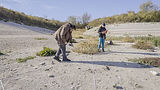
During the ongoing conflict, Moysiyenko, Khodosovtsev, Kuzemko, and Rusev have been actively documenting the impact of military operations on Ukraine’s cultural heritage sites and their associated biodiversity. These areas, often strategically exploited for military purposes, face intensified habitat destruction and ecological disruption. Working alongside them, Kravchenko has been leading legal efforts to hold perpetrators accountable for environmental crimes under international law, while Polyanska has been gathering field data and mobilizing support to protect endangered species and habitats under threat. Together, their work exposes the often-overlooked environmental toll of war and defends the rights of nature in a time of destruction.
Anna Kuzemko
Environmental Lawyer
Anna Kuzemko is a leading Ukrainian botanist and ecologist whose work focuses on grassland and steppe ecosystems, habitat classification, and biodiversity conservation. A senior researcher at the Institute of Botany of the National Academy of Sciences of Ukraine, she also collaborates with Masaryk University in the Czech Republic and serves on international scientific committees related to vegetation science and conservation.
Her research highlights the ecological importance of Ukraine’s rapidly disappearing steppe zones, which once covered 40% of the country and now comprise just 2–3%. She has emphasized the critical role of endemic species and the need for active restoration strategies, such as hay transfer methods to regenerate native plant communities. Her work combines field ecology, policy advocacy, and education to support long-term environmental recovery in regions damaged by conflict and industrial agriculture.
Kuzemko is also a founding member of the Ukrainian Nature Conservation Group and has spoken widely about the ecological consequences of war, including in the Chernobyl Exclusion Zone and post-flood zones affected by the Kakhovka dam destruction. Through science, fieldwork, and public engagement, she champions the protection of Ukraine’s unique ecosystems and plant heritage.


CLEAN AND JERK


61
KG
WEIGHT CLASSES FOR
WOMEN
49
KG
71
KG
+81
KG
59
KG
81
KG
ABOUT THE RACE
HURDLING ORIGINATED IN ENGLAND IN THE EARLY 19TH CENTURY, THE RUNNERS RACE OVER A SERIES OF OBSTACLES CALLED HURDLES, WHICH ARE SET A FIXED DISTANCE APART.
RUNNERS MUST REMAIN IN ASSIGNED LANES THROUGHOUT A RACE, AND, ALTHOUGH THEY MAY KNOCK HURDLES DOWN WHILE RUNNING OVER THEM, A RUNNER WHO TRAILS A FOOT OR LEG ALONGSIDE A HURDLE OR KNOCKS IT DOWN WITH A HAND IS DISQUALIFIED. THE FIRST HURDLER TO COMPLETE THE COURSE IS THE WINNER.


HURDLES


TOBI
AMUSAN
(NIGERIA) WOMEN / 100M / 2022
12.12
12.12
12.12
12.12


KARSTEN WARHOLM
(NORWAY) MEN / 400M / 2021
45.95
45.95
45.95
45.95
